


Have you ever found yourself thinking that life would be better if you had more? Perhaps a bigger house, a better car, a more successful career, more free time or better relationships. We often imagine that if we could just achieve or acquire these things, we would feel happier, more fulfilled and more successful.
There’s nothing wrong with wanting more from life. However, perhaps the problem lies in how we approach getting it.
We live in a society that encourages us to believe that having more will make us happier. Yet, as many of us discover, achieving more doesn’t necessarily bring the fulfilment we expected. We can reach our goals, acquire the things we wanted, and still feel that something is missing.
This is where the Be, Do, Have model offers a different perspective. It suggests that lasting change starts not with what we want to have, or even what we need to do, but with who we need to become.
The Three Stages: Be, Do, Have
Most people approach goal setting by identifying something they want to HAVE and then deciding what they need to DO to achieve it.
But there’s another, often overlooked question:
Who do I need to BE to achieve the results I want?
Our beliefs, values, attitudes, mindset and sense of identity all influence how we behave and the choices we make. The person we are being influences the actions we take, and those actions influence the results we achieve.
In other words, lasting success involves more than simply doing things differently. It requires us to consider the qualities and characteristics that will help us sustain those changes.
An Example: Becoming a Successful Concert Pianist
Imagine that I want to become a highly successful concert pianist, performing at prestigious venues around the world.
Rather than simply asking how many hours I need to practise or which pieces I should learn, I could start with a more fundamental question:
Who do I need to become to achieve this ambition?
I would probably need to become exceptionally disciplined, resilient, self-motivated and open to constructive criticism. I would need the confidence to perform under pressure, the determination to persevere when things become difficult and the willingness to keep learning.
I’d also need to think beyond my musical ability. How would I present myself professionally? How would I build relationships within the music industry, promote my work and manage the business side of my career?
Clearly, becoming a successful concert pianist involves more than developing technical excellence. It requires becoming the kind of person who can meet the demands of that career.
This is the essence of Be, Do, Have: develop the qualities needed to achieve your goal, take actions that reflect those qualities and work towards the results you want.
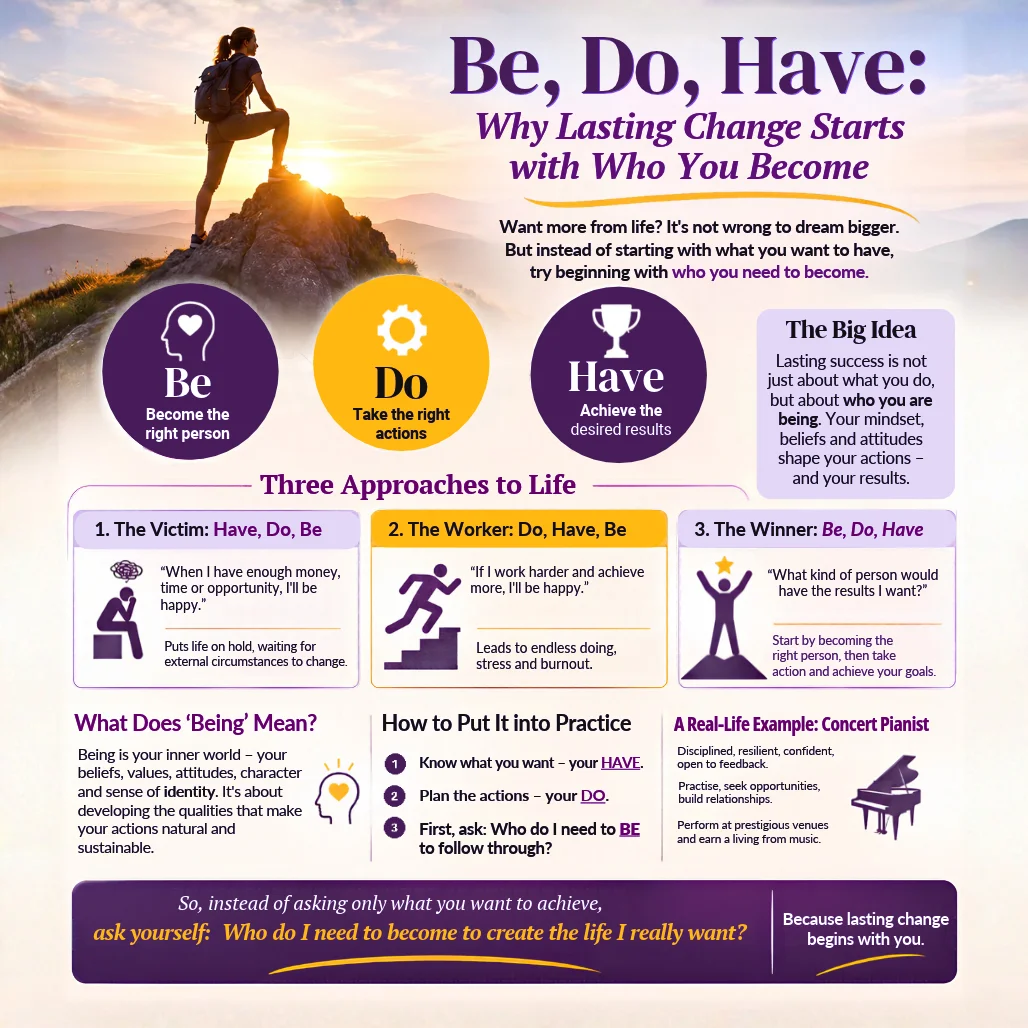
Three Different Approaches to Life
Jaemin Frazer describes three approaches to achieving success, which he calls the Victim, the Worker and the Winner. Each represents a different way of thinking about our goals and our ability to influence outcomes.
-
The Victim: Have, Do, Be
The Victim believes that life will improve once external circumstances change.
Their thinking might sound like this:
“When I have enough money, time, support or opportunity, I’ll be able to do the things I really want to do. Then I’ll be happy.”
The difficulty with this approach is that it puts life on hold. Progress depends on circumstances changing or on having something that may not yet be available. There is always another reason to wait.
-
The Worker: Do, Have, Be
The Worker believes that success comes primarily from working harder and doing more.
Their thinking might be:
“If I work harder and achieve more, I’ll have greater success, and then I’ll be happy.”
The problem is that there is often no natural finishing point. The more we achieve, the more we want to achieve. We can become so focused on doing and achieving that we lose sight of why we started in the first place.
This approach can lead to exhaustion, stress and burnout, with happiness continually postponed until the next achievement.
-
The Winner: Be, Do, Have
The Winner takes a different approach. Rather than waiting for circumstances to change or simply working harder, they begin by considering who they need to become.
Their thinking is:
“What kind of person would achieve the results I want? What qualities, beliefs and attitudes would that person have? What would they do differently?”
They then align their actions with the person they are becoming. Instead of constantly reacting to external demands, they make more conscious choices based on their values, strengths and aspirations.
The key distinction is that they take responsibility for what they can influence, rather than waiting for everything around them to change.
What Does ‘Being’ Actually Mean?
The idea of ‘being’ can sound rather abstract, so it’s worth explaining what it means in practical terms.
Being is about your internal world: your beliefs, values, attitudes, character, thoughts, emotional responses and sense of identity.
For example:
- As a leader: You might need to develop greater self-awareness, confidence in decision-making, emotional intelligence and the ability to have difficult conversations.
- As a writer: You might need to become more curious, disciplined, receptive to feedback and willing to persevere when inspiration is lacking.
- For better health: You might need to become someone who values their wellbeing, makes time for exercise and takes responsibility for daily habits.
In each case, the change is not simply about doing something differently. It’s about developing the attitudes, beliefs and behaviours that make those actions more natural and sustainable.
Of course, simply thinking differently won’t automatically make everything happen. We still need practical action, skills, commitment and an awareness of external circumstances that may affect our progress.
The value of the model is that it encourages us to look beyond the actions themselves and consider the person behind them.
How to Put Be, Do, Have into Practice
An effective way to use this model is to start with your desired outcome, then work backwards to identify the actions and personal qualities that will help you achieve it.
Let’s return to our concert pianist.
HAVE: She wants to perform at prestigious international venues and earn a sustainable living from her musical career.
DO: She needs to practise consistently, work with an excellent teacher, seek performance opportunities, develop professional relationships and build her reputation.
BE: She needs to be disciplined, resilient, confident, self-motivated, open to feedback and willing to keep developing her skills. She also needs to become comfortable performing under pressure and managing the business aspects of her career.
Notice that each element plays an important role. Her vision gives her direction, her actions move her forward, and the qualities she develops help her sustain those actions and navigate challenges along the way.
You can apply the same questions to almost any area of your life:
- What do I really want to HAVE or achieve?
- What do I need to DO to move towards it?
- Who do I need to BE to make those actions possible and sustainable?
The third question is particularly valuable because it encourages us to identify the personal development we may need alongside our practical goals.
Start by Asking a Different Question
Many of us measure progress by what we do and what we have. We set targets, work harder, acquire more and hope that eventually we will feel successful and fulfilled.
The Be, Do, Have model invites us to pause and look at things differently.
Instead of asking only what you want to achieve or what you need to do, consider asking yourself:
Who do I need to become to create the life, career or relationships I really want?
It’s a question that encourages greater self-awareness, personal responsibility and a more meaningful approach to change.
Ultimately, lasting change isn’t just about achieving a particular goal. It’s also about becoming someone who can create, experience and sustain the results they are looking for.
Because the most meaningful transformation doesn’t begin with what you have. It begins with who you become.