


If you are reading this between back-to-back meetings, with forty-nine unread messages waiting and a soft knot in your stomach that never quite unties—take a breath. You don’t have to fix anything in the next three minutes. Just let your shoulders drop a few centimetres. I bet you didn’t even notice how far up they were!
On paper, things probably look fine. You’re capable, you’re reliable, and people count on you to have the answers. When things get messy, you’re the one who steps in and creates order out of the chaos. That grit and sense of responsibility are likely what built your career.
Until lately.
Lately, the strategies that used to work—working a little later, pushing through the fatigue, powering on with another coffee and sheer willpower—aren’t cutting it anymore. Instead, everything feels heavier than it should. Simple decisions take twice as long, your patience is wearing thin, and the thought of carrying this pace for another six months- even another month feels quietly overwhelming.
If you’ve reached the end of your rope, I want you to hear something clearly: you aren’t broken, and you haven’t lost your edge. You are simply running a high-performance engine on an empty tank. And when pushing through stops working, the answer isn’t to try harder—it’s to change how you carry the load.
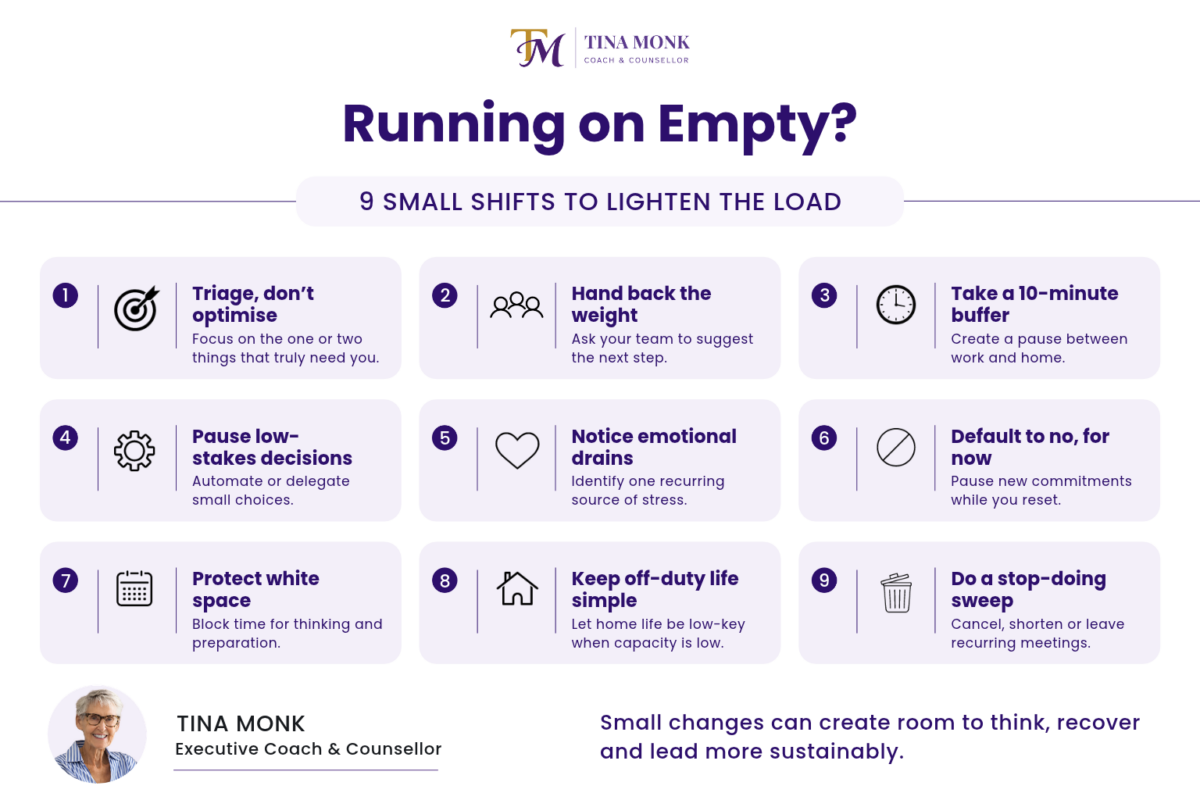
Practical Shifts for When You’re Running on Empty
When you’re at the end of your rope, the last thing you need is a complicated new morning routine or a complete calendar overhaul. You need relief you can feel this week. I suggest you start with any or all of these small shifts:
-
Triage, don’t optimise
When your capacity is low, trying to do everything to your usual high standard will break you.
Look at your to-do list today and ask one honest question: What breaks if this doesn’t get done this week? Pick the one or two priorities that genuinely require your leadership and give yourself permission to let the non-essential balls drop—or simply wait. Good enough is a valid strategy right now.
-
Hand back the weight you aren’t meant to carry
Exhausted leaders often become bottlenecks without meaning to. Leadership coaching can help leaders recognise these patterns and develop a more effective approach to supporting their teams.
When a team member brings you a problem, resist the urge to immediately solve it just because it’s faster. Instead, pause and ask them, “What do you think our best next step is?” or “How would you handle this if I weren’t in the room?” It takes a few minutes, builds your team’s capability, and takes one more decision off your plate.
-
Build a 10-minute decompression buffer
Most leaders walk straight from a high-stakes Zoom call into dinner, family life, or answering emails from the couch. Your nervous system rarely gets the signal that the workday is over.
Create a hard, 10-minute boundary between work and personal time. Go for a walk without your phone, sit in your car in silence before walking inside, or step outside for a cup of tea. You aren’t trying to “fix” your stress in those ten minutes—you’re just letting the dust settle.
-
Institute a “Low-Stakes Decision” Moratorium
Decision fatigue hits depleted leaders hardest on trivial things (what to eat, when to schedule a routine call, minor formatting choices), draining energy needed for big calls.
Automate or delegate every non-essential choice for two weeks. Eat the same three breakfasts, let someone else pick the meeting time or restaurant, and batch minor approvals into one 15-minute block a day.
-
Audit Your “Emotional Leakages”
Often, it isn’t the hours worked that exhaust a leader—it’s the quiet emotional weight of managing one difficult stakeholder, delaying a hard conversation, or absorbing a team member’s anxiety.
Name the one person, meeting, or unresolved issue that leaves you feeling drained every time it crosses your mind. Addressing or containing that single “leak” often frees up more energy than taking a Friday off.
-
Switch to “Default-to-No” (With a Grace Period)
High-performing leaders say yes out of habit, guilt, or optimism about their future energy.
Put a temporary moratorium on new commitments for 30 days. Use this simple script immediately: “I’d love to support this, and I want to give it proper attention. My plate is completely full until next month—can we revisit this then?”
-
Schedule “White Space” Like a Board Meeting
An open slot on your calendar gets swallowed within hours by urgent requests.
Block two 45-minute windows a week labelled “Admin / Prep” (so no one books over them) and use them strictly to catch up, stare out the window, or take a slow walk. No new tasks allowed.
-
Lower the Bar on “Off-Duty” Life
Exhausted leaders often feel guilty about not being present parents, partners, or friends, which adds shame to exhaustion.
Communicate your low battery honestly to the people at home: “I’ve had a heavy week, and my tank is at 15%. I really want to spend time with you tonight, so can we keep things super quiet and low-key?” It removes the pressure to perform at home.
-
Do a “Stop-Doing” Calendar Sweep
Leaders rarely remove recurring meetings once they’ve served their purpose.
Look at next week’s recurring meetings and cancel, shorten (from 60 minutes to 25), or step out of just two. Immediate breathing room without adding a single task.
You Don’t Have to Carry This Alone
Leadership can be isolating, especially when everyone around you assumes you have it all together. You don’t need to wait until you completely burn out to seek support. Burnout and Stress Counselling can provide a confidential space to understand what you’re experiencing, regain perspective and find a more sustainable way forward. You don’t have to figure out the next chapter by yourself.
If you’re tired of white-knuckling your way through the week and want a confidential, grounded space to catch your breath and find a more sustainable way to lead, I’d love to help.